Bedding · Materials & Care
Organic Relaxed Sheet Sets: Reading the Details Behind a Softer Bed
The appeal of relaxed linen isn’t just its easy, lived-in look. It begins with flax, takes shape on the loom, and is refined through finishing, sewing, and care. Knowing how those details work together can help you choose bedding that feels right from the first night—and grows more comfortable with time.
Published November 3, 2026
The feeling starts with the fiber
There’s a particular kind of calm to a bed made with linen. The surface is softly irregular rather than sleek, the drape feels substantial without appearing stiff, and the overall effect is less “perfectly pressed” than comfortably settled. An organic relaxed sheet set brings that character to a daily-use textile, but the words on the label describe more than a style. They point to decisions about the plant fiber, the fabric’s construction, the finishing process, and the way the pieces are meant to fit and wear.
Linen is made from flax. The stalk is processed to separate its usable fibers, which are then spun into yarn and woven into fabric. Fiber length and quality, yarn preparation, weave structure, and finishing all influence the result. That is why two products both called linen can differ noticeably in weight, texture, drape, and initial softness.
Organic describes how the flax is grown and how the material is handled under the relevant certification standard; it does not, by itself, promise a particular softness or weight. When a product is GOTS certified, for example, the certification refers to requirements across the textile’s organic processing chain, not simply to a pleasing hand-feel. It is useful to distinguish a documented certification from broad environmental language, and to read the actual product details rather than assume every linen item has the same credentials.
Some organic linen bedding lists flax grown in France and fabric woven in Portugal. Those are separate steps in a material’s journey: the origin of the crop and the location of weaving are not interchangeable. A transparent description makes that distinction clear, giving the reader a better sense of where the textile comes from without implying that a single country of origin tells the whole story.
Why linen has a relaxed texture
Linen’s characteristic texture comes partly from the flax fibers themselves. They are not perfectly uniform, and small variations in yarn can create the gentle slubs and visual movement that give the fabric its recognizable surface. A relaxed linen is not necessarily loosely made or careless in construction. “Relaxed” generally describes the finished look and feel: softer, less formal, and more naturally rumpled than a crisp, tightly pressed sheet.
Weave matters, too. A sheet’s construction determines how yarns cross one another, affecting the textile’s density, drape, and feel against the skin. Descriptions such as “breathable” or “temperature regulating” are often used for linen because the fabric can allow air movement and manage moisture in everyday use. Those qualities can contribute to comfort, but they do not mean that one sheet set will feel identical for every sleeper, bedroom, or season. Room temperature, bedding layers, personal preferences, and the weight of the fabric all play a part.
Weight is one detail that helps describe a linen fabric, though it should not be treated as a simple quality score. A heavier cloth may feel more substantial and drape differently; a lighter one can feel less weighty on the bed. Neither is automatically the better choice. Consider whether you like a pronounced linen hand or prefer a more delicate layer, and compare the stated weight when manufacturers provide it. Thread count, which is commonly used in discussions of cotton, does not translate neatly into a universal quality ranking for linen.
That surface changes with use. Linen is known for becoming more pliable with laundering and regular handling, so the first impression may not be the last. A garment-washed or stone-washed finish can give fabric a softer, more settled feel before it reaches the bed. Washing should not erase linen’s character; the goal is to maintain the fiber while allowing it to develop naturally.
Finishing is part of the story
Finishing describes treatments that help determine a fabric’s final hand, appearance, and performance. A relaxed sheet set may be garment-washed, stone-washed, or finished with a softener. These terms are not identical, and product descriptions should make clear which applies. A plant-based softener, for instance, is a stated finishing choice; it should not be taken as proof that every stage of production is chemical-free or that the fabric requires no care.
Color treatments are another detail worth noticing. Low-impact dyes may be specified for some linens, while other products emphasize undyed or naturally toned fabric. If color matters to you, look for precise information about the dyeing and certification rather than relying on phrases such as “natural” or “eco-friendly” alone. Organic fiber and dye practices are related parts of a textile’s story, but they are not synonyms.
Small finishing details can also give a sheet set its quiet polish. Pick stitching along a cuff, a clean hem, or carefully finished seams may be subtle from across the room, yet these are the areas handled repeatedly when bedding is changed and laundered. Decorative details do not guarantee durability, but neat, consistent sewing is a useful sign of attention to construction.
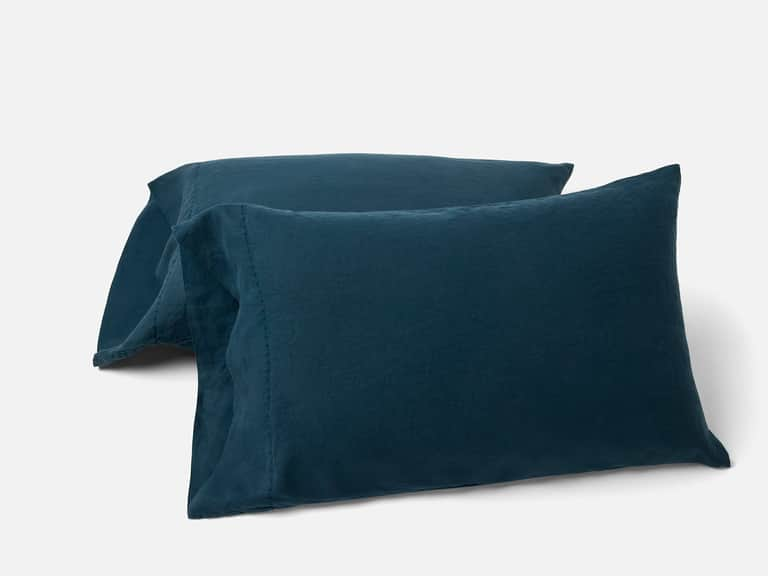
For a coordinated bed, matching pieces can extend the same material and color story across the sleep surface. Organic relaxed linen pillowcases, for example, may share the fiber and finish of a sheet collection while adding a small tailored detail at the cuff. One example is Organic Relaxed Linen Pillowcases, described as French-grown organic flax woven in Portugal, with pick-stitched cuffs and care instructions for cold, gentle washing. As with any bedding, check the specific item’s current details before assuming its specifications match another product in a collection.
A fitted sheet is a matter of fit
The most beautiful linen in the world will be frustrating if the fitted sheet will not stay in place. Pocket depth is the measurement to compare with your mattress, but it is not always the whole story. Mattress toppers, protectors, and the mattress itself add to the total height. Measure the complete sleeping surface from the bottom edge to the highest point, then compare that figure with the listed pocket depth, leaving a little practical room for the sheet to tuck under.
A 15-inch pocket is common among the organic relaxed linen sets and fitted sheets described in this category. That number is a helpful starting point, not a guarantee of compatibility with every bed. Mattress profiles vary, and elastic placement and fabric cut can affect how securely a sheet sits. If the mattress is close to the stated limit, consult the sizing guidance for the exact set or fitted sheet rather than relying on the pocket measurement alone.
Full elastic around the fitted sheet’s perimeter can help it grip the mattress evenly. A well-fitting elastic edge reduces the chance that a corner will pull free as you move during the night, though correct sizing remains essential. Check whether a listing specifies full elastic or elastic only at the corners. Also confirm the mattress size—Twin, Queen, King, or another format—because a suitable pocket depth cannot compensate for a sheet that is the wrong width or length.
Set contents deserve the same attention. A “sheet set” often includes a flat sheet, a fitted sheet, and pillowcases, but the number and size of pillowcases can vary with the bed size. Twin sets may include one pillowcase while larger sizes may include two; product descriptions may also distinguish Standard/Queen from King pillowcases. Read the included-items list before purchasing so that the set matches the pillows you actually use.
Care that preserves the feel
Linen care is straightforward when you follow the instructions attached to the particular fabric. Organic relaxed linen commonly calls for machine washing in cold water on a gentle cycle, with like colors. A mild or plant-based detergent may suit your routine, but the product’s care label should take priority over general advice. Avoid assuming that every linen can be washed in warm water or treated like a sturdy cotton towel.
Use a washer load that gives the sheets room to move. Overcrowding can increase friction and make rinsing less effective; washing linen with items that have zippers, hooks, or rough surfaces can also encourage snags. Separating similar colors is especially important when bedding is new or deeply colored. Promptly remove the sheets after washing to reduce creasing and prevent damp laundry from sitting in the machine.
Many relaxed linen sheets can be tumble-dried on low heat. High heat and prolonged drying can be unnecessarily harsh on fibers, so check the instructions and avoid leaving the fabric in the dryer after it is dry. Line drying is another option when space and conditions allow. If you prefer a smoother finish, a warm iron may be used when the care directions permit it; if you enjoy the naturally rumpled look, ironing is not essential.
Skip bleach unless the label specifically permits it. Harsh treatment can affect color and fiber strength, while fabric softener is usually unnecessary when a sheet already has a softening finish. Linen’s appeal lies partly in its evolving hand, so a little texture is not a flaw to correct. With regular, sensible laundering, the fabric can become more pliable while retaining the visual character that made it appealing in the first place.
How to judge the whole sheet set
When comparing organic bedding, it helps to look beyond a single headline claim. Start with the fiber composition: is the sheet 100% flax linen, a blend, or a fabric described more generally? Then check whether organic certification is named, whether the origin of the flax and the location of weaving are stated, and whether the construction details are specific enough to be useful.
- Material: Confirm the stated fiber content and whether the textile is linen made from flax.
- Certification: Look for the certification name and scope rather than relying on an unsupported “organic” claim.
- Construction: Note the weave description, fabric weight if listed, seam finishing, and cuff details.
- Fit: Compare mattress dimensions and total depth with the fitted sheet’s pocket measurement.
- Set contents: Verify the included flat sheet, fitted sheet, and pillowcase quantities and sizes.
- Care: Follow the item-specific wash and drying directions, especially for color and finish.
These details are more useful than treating softness as a fixed promise. One sleeper may love the tactile texture of washed linen; another may prefer a smoother cotton percale. Even within linen, a heavier weave, a different wash, or a distinct finish can change the first impression. If possible, think about what you already like in bedding: cool and crisp, gently textured, drapey, or substantial. That preference can guide you more reliably than a marketing adjective.
Building a bedroom around texture
Relaxed linen gives a bedroom an easy foundation because its surface brings visual interest without requiring a bold pattern. A simple palette can let the weave do the work. White, flax, soft gray, and muted earth tones tend to pair naturally with wood, painted furniture, and other quiet materials, while a deeper color can make the bed feel more grounded. The key is not to make every layer identical: a smooth coverlet, a textured pillow, or a contrasting blanket can create a considered mix.
Layering also has a practical side. A flat sheet adds a washable barrier between sleeper and duvet, while a duvet cover makes it easier to refresh the bed without laundering the insert each time. Pillowcases can coordinate with the sheets or introduce a subtle variation in tone. Decorative cushions are optional; the bed should still feel comfortable and uncomplicated when they are removed at night.
In a city apartment, care routines may need to fit limited storage, shared laundry rooms, or a compact drying area. Linen’s relaxed appearance can be forgiving when there is no room to press every piece, but the best routine is the one you can sustain. Wash bedding on a regular schedule suited to your household, allow it to dry fully, and store it in a clean, dry place with enough room to breathe. Keep the care label accessible until the instructions become familiar.
A carefully made bed does not have to look untouched. Relaxed linen is at its most convincing when it feels lived in: a soft fold at the edge, a natural crease, the small irregularities of woven flax. Choosing a sheet set is ultimately a decision about how you want the room to feel and how much care you want to give it. When fiber, finish, fit, and laundering all make sense together, the result is less about a showroom-perfect surface and more about a bedroom that welcomes you back night after night.
The details worth remembering
An organic relaxed sheet set is defined by more than a label. Flax fiber gives linen its distinctive character; weaving and finishing shape its weight and hand; careful sewing and elastic help it function; and appropriate laundering allows its texture to evolve. Check certification and origin claims, measure the mattress rather than guessing, confirm what the set contains, and follow the care instructions for the exact textile.
That little bit of label-reading can make the difference between bedding that simply looks appealing and bedding that feels right in daily life. The reward is a softer, more personal bed—one whose character develops gradually, wash after wash.